

Note
Go to the end to download the full example code.
Choosing an optimisation algorithm#
Run SA, SCE and ESE under a shared budget and weigh final score against elapsed time.
A team has already settled on phi_p (maximin separation) as the right
criterion for a mid-sized numeric design, but wants to know which of
Mergen’s three optimisers gets there fastest and best under a limited
compute budget. Running the same criterion with multiple algorithms
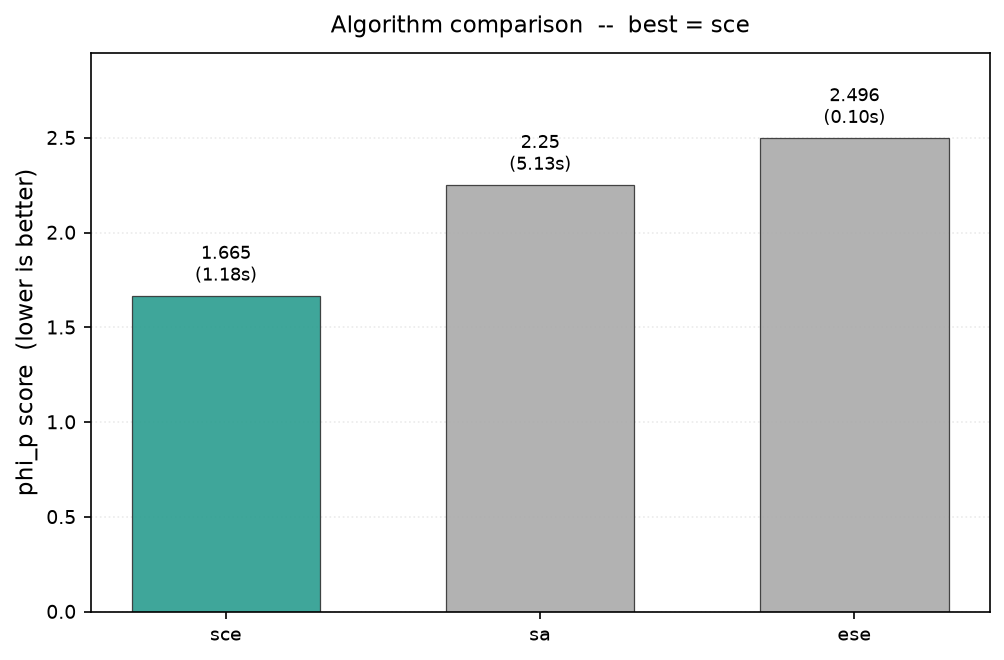
produces a direct, self-explanatory bar chart comparing their scores.
Parameters#
factor_a, factor_b, factor_c, factor_d (0.0-1.0, continuous, rounded to 3 decimals): four generic normalised inputs, large enough that the choice of optimiser starts to matter; rounding keeps the node values clean.
What to look at#
comparison_1.png(saved plot): a bar chart with one bar per algorithm, thephi_pscore on the y-axis (lower is better) and the elapsed time annotated above each bar; the best algorithm is highlighted. This is the direct answer to “which optimiser wins”, unlike a pairplot, which only shows point coverage, not the optimisation outcome.The printed
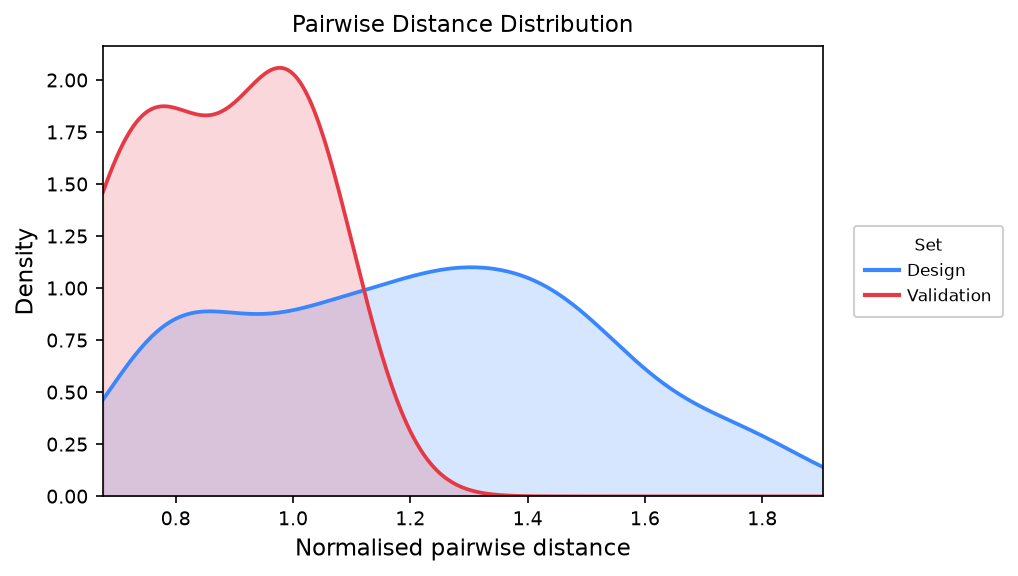
summary(): confirms all three runs share the same criterion, so their scores are directly comparable (unlike comparing different criteria, which requires percentile ranking).distances_1.png(saved plot): for a maximin-style criterion, the pairwise-distance distribution of the winning design, pushed away from zero, is the natural coverage check.
Mergen features used#
Sampler.run(algorithm=[...]): the same criterion optimised by every named algorithm in one call; the result carries algorithm_results and best_algorithm.result.plot('comparison'): the dedicated bar chart for this same-criterion, multi-algorithm case.Sampler.set_optimizer(): called once per algorithm to fix a shared, modest compute budget, so the comparison reflects a fixed cost rather than each optimiser’s own (much heavier) defaults.
Estimated runtime: a few minutes (three optimisations under a shared compute budget).
from mergen import ParameterSpace, Sampler

# 1. Define a four-factor numeric space. The grid resolution is kept
#    moderate so the three-way optimiser comparison below finishes in
#    a few minutes; a finer resolution is fine for production use of
#    a single, chosen algorithm.
space = ParameterSpace({
    'factor_a': ('continuous', 0.0, 1.0, {'resolution': 20, 'round': 3}),
    'factor_b': ('continuous', 0.0, 1.0, {'resolution': 20, 'round': 3}),
    'factor_c': ('continuous', 0.0, 1.0, {'resolution': 20, 'round': 3}),
    'factor_d': ('continuous', 0.0, 1.0, {'resolution': 20, 'round': 3}),
})

# 2. Fix a shared, modest compute budget for each optimiser, then run
#    all three on the same criterion in a single call.
sampler = Sampler(space)
sampler.set_design(n_samples=20)
sampler.set_optimizer('sa', n_restarts=2, max_iter=300)
sampler.set_optimizer('sce', n_restarts=2, max_iter=300)
sampler.set_optimizer('ese', M=30, J=15)
result = sampler.run(
    criteria='phi_p', algorithm=['sa', 'sce', 'ese'],
    n_jobs=1,  # one core; set n_jobs=-1 to run the algorithms in parallel
)

# 3. Inspect and save the outcome.
result.summary()
result.plot('comparison', save=True)
result.plot('distances', save=True)
  [WARNING]  n_samples (20) < recommended 10*n_parameters (40, Loeppky et al. 2009). Design quality may be reduced.

════════════════════════════════════════════════════════════
  MERGEN — Space-filling Design
════════════════════════════════════════════════════════════
  Parameters      : 4
  Candidates      : 160,000
  n_samples       : 20  (prescribed_in=0, focus_in=0, optimised_slots=20)
  Total design    : 20
  Validation      : 4
  Criterion       : phi_p
  Algorithm(s)    : sa, sce, ese
────────────────────────────────────────────────────────────
  [MERGEN]   Optimising (criterion=phi_p, algorithms=sa, sce, ese)...
  [SA]       Restart 1/2
  [SA]       Tuning temperature...
  [SA]       Start  log(score)=1.986  T=1.0963e-01  iters=300  swappable=20  hybrid=0.50
  [SA]       Done   log(score)=0.865  (accepted=79/300, rate=26.3%)
  [SA]       Restart 1: new best  log(score)=0.865
  [SA]       Restart 2/2
  [SA]       Tuning temperature...
  [SA]       Start  log(score)=0.970  T=2.7473e-02  iters=300  swappable=20  hybrid=0.50
  [SA]       Done   log(score)=0.811  (accepted=43/300, rate=14.3%)
  [SA]       Restart 2: new best  log(score)=0.811
  [SCE]      Restart 1/2
  [SCE]      Start  log(score)=1.986  max_iter=300  swappable=20  K_axis=30
  [SCE]      Done   log(score)=0.531  (accepted=125/300, sweeps=4)
  [SCE]      Restart 1: new best  log(score)=0.531
  [SCE]      Restart 2/2
  [SCE]      Start  log(score)=1.471  max_iter=300  swappable=20  K_axis=30
  [SCE]      Done   log(score)=0.510  (accepted=78/300, sweeps=4)
  [SCE]      Restart 2: new best  log(score)=0.510
  [ESE]      Start  log(score)=1.986  T0=3.643e-02  M=30  J=15  Q=1  swappable=20
  [ESE]        outer 1.1/1  T=3.643e-02→2.915e-02  acc_ratio=0.97  imp_ratio=0.97  best log(score)=0.915
  [ESE]      Done   log(score)=0.915  (accepted=29/30, improved=29)
  [MERGEN]   sa     done -- score=2.25  (elapsed 5.1s)
  [MERGEN]   sce    done -- score=1.665  (elapsed 1.2s)
  [MERGEN]   ese    done -- score=2.496  (elapsed 0.1s)
  [MERGEN]   Best: sce  score=1.665  (total elapsed 6.5s)

────────────────────────────────────────────────────────────
  MERGEN — Final Design
────────────────────────────────────────────────────────────
  Prescribed (in)  : 0
  Prescribed (out) : 0
  Focus (in)       : 0
  Focus (out)      : 0
  Optimised        : 20
  Total design     : 20
  Validation       : 4
════════════════════════════════════════════════════════════

────────────────────────────────────────────────────
  MERGEN Design Summary
────────────────────────────────────────────────────
  Optimised       : 20
  Total design    : 20
  Validation      : 4
────────────────────────────────────────────────────
  Parameters      : 4
  Candidates      : 160000
  Criterion       : phi_p
  Seed            : 44
  Algorithms      : sa, sce, ese
  Best algorithm  : sce
────────────────────────────────────────────────────
  Per-algorithm scores
────────────────────────────────────────────────────
   * sce    : score=1.66482  elapsed=1.18s  n_iter=600
     sa     : score=2.24955  elapsed=5.13s  n_iter=600
     ese    : score=2.49641  elapsed=0.10s  n_iter=30
────────────────────────────────────────────────────

  Saved: outputs/comparison_1.png
  Saved: outputs/distances_1.png
Total running time of the script: (0 minutes 13.559 seconds)