

Note
Go to the end to download the full example code.
How large should a design be?#
Contrast a default-size and a doubled design of the same study to see what extra runs buy.
The same four-factor study is planned two ways: once under a hard experimental budget that fixes the number of runs, and once at the default size Mergen recommends. Placing the two designs side by side shows what a larger budget actually buys, so the decision can be made before any real experiment is spent.
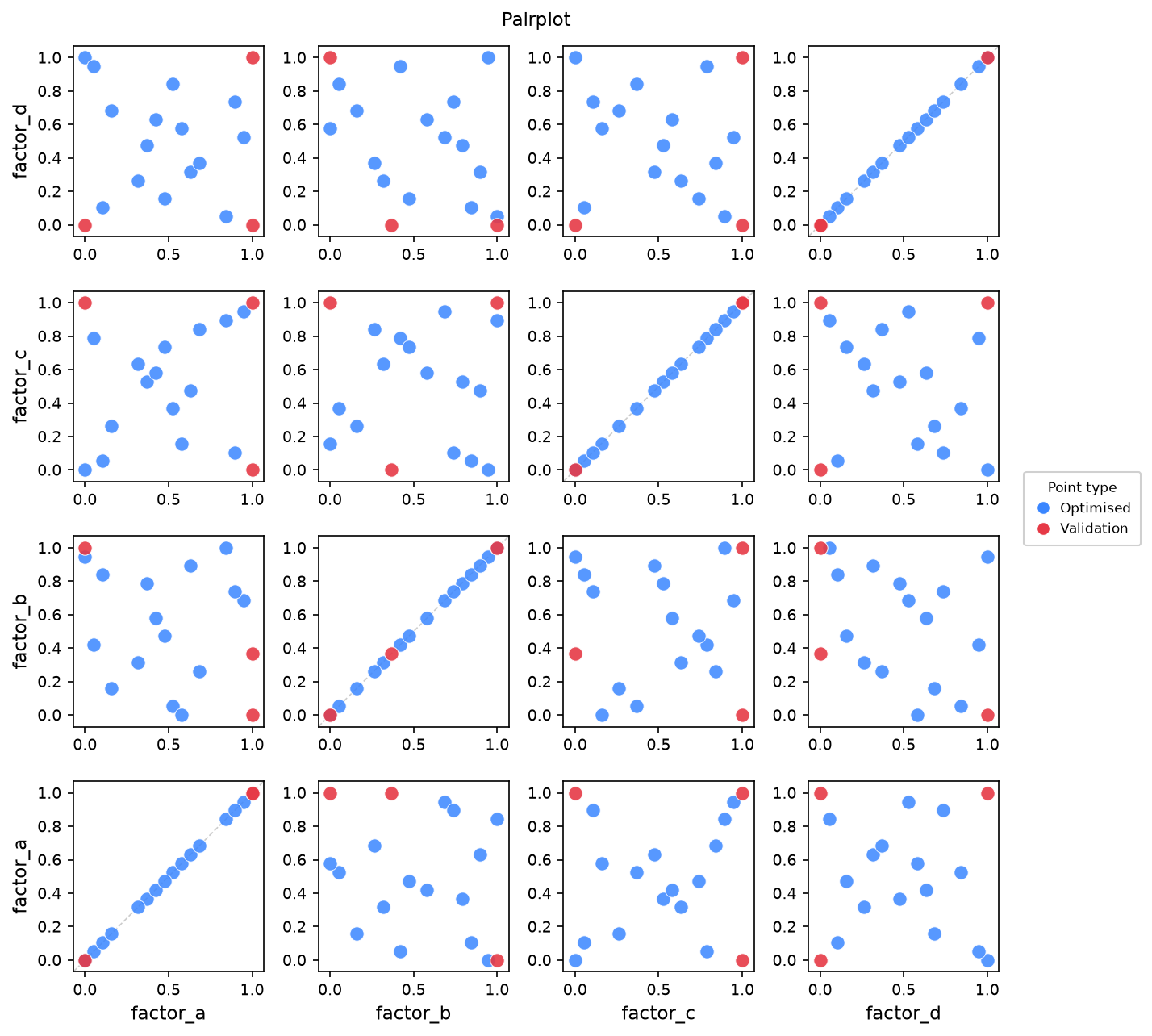
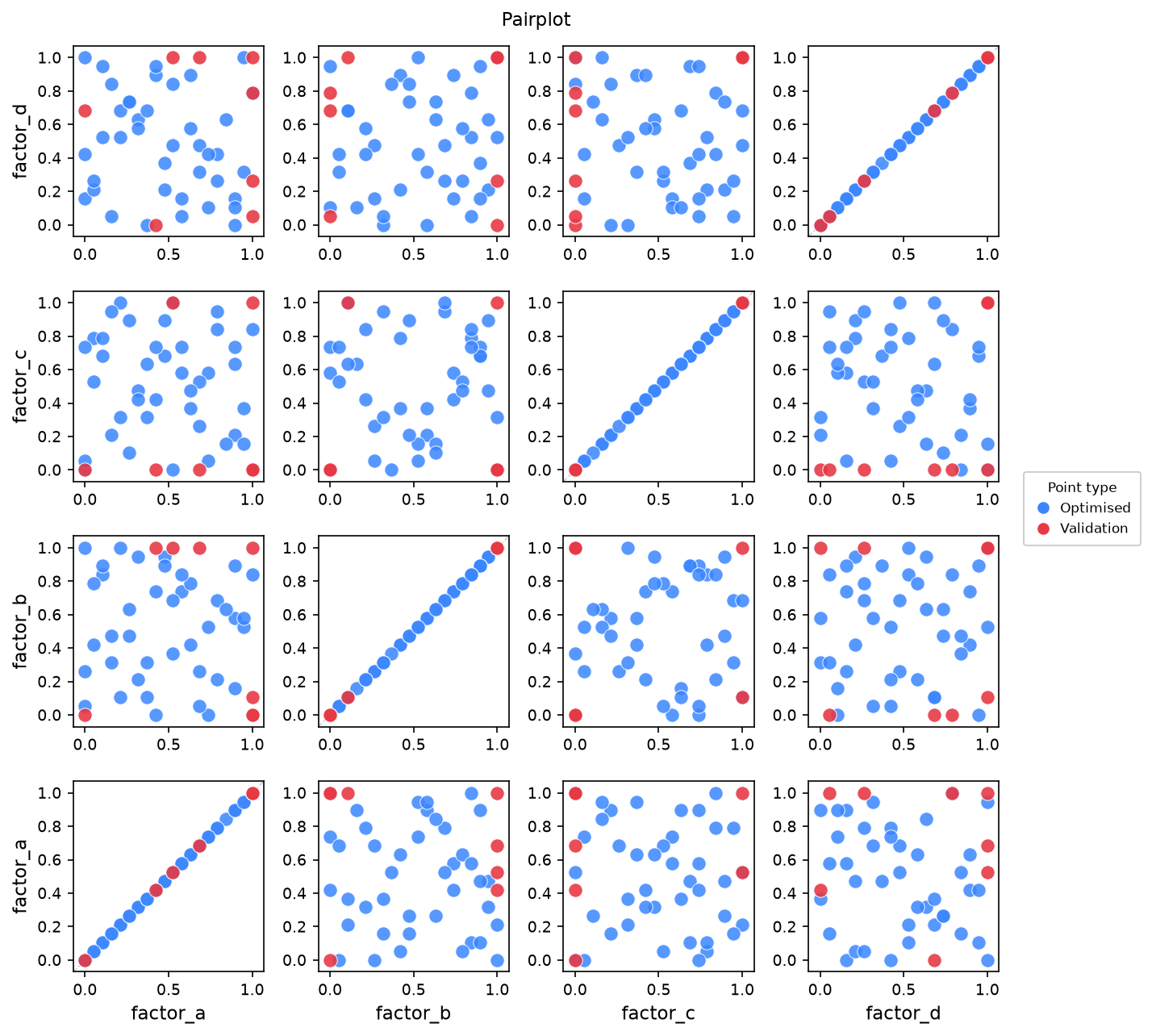
The honest comparison here is coverage, not a quality percentile. Each design is optimised to fill the space as well as it can for its size, so both score well against a random baseline; a small design is not a “bad” design. What a small design cannot do is occupy as much of the space: with fewer points, larger gaps are unavoidable. That gap in coverage, visible in the pairplot, is the real cost of a tight budget.
Parameters#
factor_a, factor_b, factor_c, factor_d (0.0-1.0, continuous, 20-level grid, rounded to 3 decimals): four generic normalised inputs. With four factors the default sample size is 10*d = 40.
What to look at#
The two saved pairplots, compared directly: the 15-run design leaves visibly larger empty regions in several 2D projections, while the 40-run design places points into those gaps. This difference in coverage, not a difference in percentile score, is what a larger budget buys.
quality_report()for both runs (printed): note that both designs score well for their size. A high percentile confirms each design is well-spread relative to random designs of the same count; it does not mean 15 runs cover the space as fully as 40. Coverage and per-size quality are different questions, and the pairplots answer the coverage one.
Mergen features used#
Sampler.set_design(n_samples=...): an explicit fixed budget in the first run, versus omitting n_samples in the second so the 10*d default applies.Two independent designs from the same parameter space, compared on coverage (pairplots) and per-size quality (quality_report).
Sampler.set_optimizer(): a modest, shared compute budget so the two runs finish quickly for a demonstration.
Estimated runtime: a minute or two (two designs).
from mergen import ParameterSpace, Sampler

# 1. Define a four-factor numeric space. With d = 4 the default sample
#    size is 10*d = 40; a rule of thumb from the computer-experiments
#    literature that a design should scale with dimensionality.
space = ParameterSpace({
    'factor_a': ('continuous', 0.0, 1.0, {'resolution': 20, 'round': 3}),
    'factor_b': ('continuous', 0.0, 1.0, {'resolution': 20, 'round': 3}),
    'factor_c': ('continuous', 0.0, 1.0, {'resolution': 20, 'round': 3}),
    'factor_d': ('continuous', 0.0, 1.0, {'resolution': 20, 'round': 3}),
})

# 2. First study: a hard budget of only 15 runs.
budget_sampler = Sampler(space)
budget_sampler.set_design(n_samples=15)
budget_sampler.set_optimizer('sa', n_restarts=2, max_iter=300)
budget_design = budget_sampler.run()

# 3. Second study: let Mergen size the design (the 10*d default).
default_sampler = Sampler(space)
default_sampler.set_optimizer('sa', n_restarts=2, max_iter=300)
default_design = default_sampler.run()

# 4. Compare per-size quality (printed), then the coverage difference
#    in the pairplots, which is the real cost of a smaller budget.
budget_design.quality_report()
default_design.quality_report()
budget_design.plot('pairplot', save=True)
default_design.plot('pairplot', save=True)
  [WARNING]  n_samples (15) < recommended 10*n_parameters (40, Loeppky et al. 2009). Design quality may be reduced.

════════════════════════════════════════════════════════════
  MERGEN — Space-filling Design
════════════════════════════════════════════════════════════
  Parameters      : 4
  Candidates      : 160,000
  n_samples       : 15  (prescribed_in=0, focus_in=0, optimised_slots=15)
  Total design    : 15
  Validation      : 3
  Criterion       : umaxpro
  Algorithm(s)    : sa
────────────────────────────────────────────────────────────
  [MERGEN]   Optimising (criterion=umaxpro, algorithm=sa)...
  [SA]       Restart 1/2
  [SA]       Tuning temperature...
  [SA]       Start  log(score)=30.177  T=1.3344e+23  iters=300  swappable=15  hybrid=0.50
  [SA]       Done   log(score)=29.861  (accepted=280/300, rate=93.3%)
  [SA]       Restart 1: new best  log(score)=29.861
  [SA]       Restart 2/2
  [SA]       Tuning temperature...
  [SA]       Start  log(score)=50.050  T=2.8713e+28  iters=300  swappable=15  hybrid=0.50
  [SA]       Done   log(score)=35.671  (accepted=277/300, rate=92.3%)
  [MERGEN]   sa     done -- score=9.304e+12  (elapsed 4.6s)

────────────────────────────────────────────────────────────
  MERGEN — Final Design
────────────────────────────────────────────────────────────
  Prescribed (in)  : 0
  Prescribed (out) : 0
  Focus (in)       : 0
  Focus (out)      : 0
  Optimised        : 15
  Total design     : 15
  Validation       : 3
════════════════════════════════════════════════════════════

════════════════════════════════════════════════════════════
  MERGEN — Space-filling Design
════════════════════════════════════════════════════════════
  Parameters      : 4
  Candidates      : 160,000
  n_samples       : 40  (prescribed_in=0, focus_in=0, optimised_slots=40)
  Total design    : 40
  Validation      : 8
  Criterion       : umaxpro
  Algorithm(s)    : sa
────────────────────────────────────────────────────────────
  [MERGEN]   Optimising (criterion=umaxpro, algorithm=sa)...
  [SA]       Restart 1/2
  [SA]       Tuning temperature...
  [SA]       Start  log(score)=55.706  T=1.2958e+29  iters=300  swappable=40  hybrid=0.50
  [SA]       Done   log(score)=53.240  (accepted=292/300, rate=97.3%)
  [SA]       Restart 1: new best  log(score)=53.240
  [SA]       Restart 2/2
  [SA]       Tuning temperature...
  [SA]       Start  log(score)=54.732  T=1.4286e+37  iters=300  swappable=40  hybrid=0.50
  [SA]       Done   log(score)=54.417  (accepted=292/300, rate=97.3%)
  [MERGEN]   sa     done -- score=1.323e+23  (elapsed 5.9s)

────────────────────────────────────────────────────────────
  MERGEN — Final Design
────────────────────────────────────────────────────────────
  Prescribed (in)  : 0
  Prescribed (out) : 0
  Focus (in)       : 0
  Focus (out)      : 0
  Optimised        : 40
  Total design     : 40
  Validation       : 8
════════════════════════════════════════════════════════════
  [METRICS]  Computing MC baseline (300 designs)...
  [METRICS]  MC baseline complete (300 designs).

════════════════════════════════════════════════════════════════════════
  MERGEN Design Metrics  (n=15, d=4)
════════════════════════════════════════════════════════════════════════
  Metric                      Value    Baseline  Better when        Rank
────────────────────────────────────────────────────────────────────────
  Min distance               0.2683      0.2232  higher         78th pct
  Minimax distance           0.8126      0.8773  lower          87th pct  *
  Max |correlation|          0.3977      0.4206  lower          59th pct  *
  2D projection CD2          0.0854      0.1584  lower         100th pct  *
  CV distances               0.3249      0.3090  lower          24th pct
  Mean distance              0.8450      0.8211  higher         71th pct
────────────────────────────────────────────────────────────────────────
  Criterion scores
────────────────────────────────────────────────────────────────────────
  UMAXPRO                    9.3041e+12  9.0264e+22  100th pct  lower
────────────────────────────────────────────────────────────────────────
  * = primarily optimised by 'umaxpro'
  For other priorities, see: mergen.criteria.list_criteria()
────────────────────────────────────────────────────────────────────────
  Baseline: 300 MC designs from feasible space  |  Rank = percentile among baseline designs
════════════════════════════════════════════════════════════════════════

  [METRICS]  Computing MC baseline (300 designs)...
  [METRICS]  MC baseline complete (300 designs).

════════════════════════════════════════════════════════════════════════
  MERGEN Design Metrics  (n=40, d=4)
════════════════════════════════════════════════════════════════════════
  Metric                      Value    Baseline  Better when        Rank
────────────────────────────────────────────────────────────────────────
  Min distance               0.2168      0.1286  higher        100th pct
  Minimax distance           0.6511      0.7075  lower          86th pct  *
  Max |correlation|          0.2342      0.2564  lower          62th pct  *
  2D projection CD2          0.0602      0.1015  lower         100th pct  *
  CV distances               0.3055      0.3169  lower          88th pct
  Mean distance              0.8313      0.8183  higher         66th pct
────────────────────────────────────────────────────────────────────────
  Criterion scores
────────────────────────────────────────────────────────────────────────
  UMAXPRO                    1.3233e+23  1.7280e+25  100th pct  lower
────────────────────────────────────────────────────────────────────────
  * = primarily optimised by 'umaxpro'
  For other priorities, see: mergen.criteria.list_criteria()
────────────────────────────────────────────────────────────────────────
  Baseline: 300 MC designs from feasible space  |  Rank = percentile among baseline designs
════════════════════════════════════════════════════════════════════════

  Saved: outputs/pairplot_5.png
  Saved: outputs/pairplot_6.png
Total running time of the script: (0 minutes 35.365 seconds)