

Compare criteria and algorithms#
When you are unsure which criterion or optimiser suits your problem,
compare() settles it empirically: it builds a design for each
candidate combination on your actual space and ranks them on all
quality metrics at once.
Comparing criteria#
from mergen import ParameterSpace, Sampler

space = ParameterSpace({
    'factor_a': ('continuous', 0.0, 1.0, {'resolution': 15, 'round': 3}),
    'factor_b': ('continuous', 0.0, 1.0, {'resolution': 15, 'round': 3}),
    'factor_c': ('continuous', 0.0, 1.0, {'resolution': 15, 'round': 3}),
})

sampler = Sampler(space)
sampler.set_design(n_samples=30)

comparison = sampler.compare(
    priority=('min_distance', 'max_abs_correlation'),
)
With criteria left unset, compare() evaluates every criterion
compatible with the space. Each combination is optimised several times
(n_repeats, default 5) and ranked on the mean metric percentile, so
the winner reflects typical rather than lucky single-run performance.
The priority argument names the metrics that break ties, in order of
importance.
Reading and saving the result#
comparison.to_markdown('comparison_table.md')

best = comparison.best_result
best.quality_report()
best.plot('pairplot', save=True)
best.to_csv('winner_design.csv')
comparison.best_result is an ordinary result object, so the full
reporting and export interface is available on the winner.
The comparison itself has a plot: a heat map of the percentile-rank table, with one row per criterion and algorithm combination, one column per quality metric, and the winning row starred.
comparison.plot(save=True)
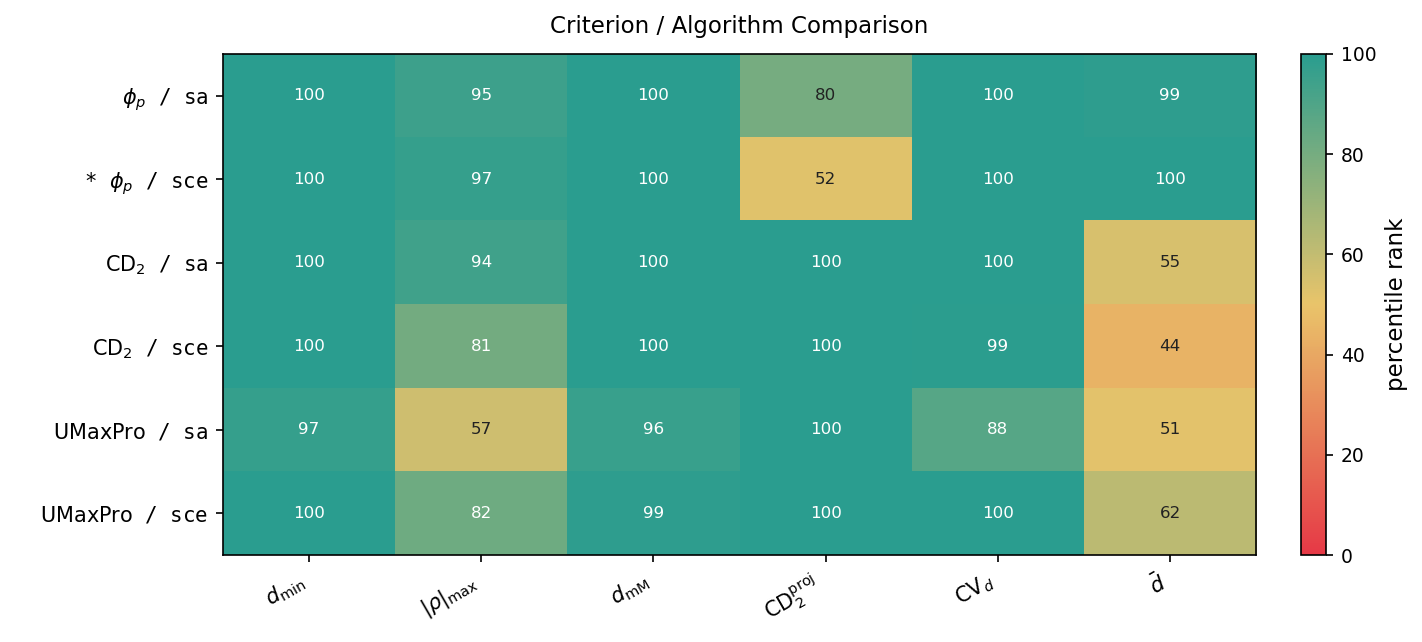
A small sweep (three criteria, two optimisers, two repeats each) on a two-parameter space. Each cell is the mean percentile rank of that combination on that metric; the starred row won under the requested priority.#
Comparing algorithms#
To hold the criterion fixed and compare optimisers instead, pass a
list of algorithms to run:
result = sampler.run(criteria='phi_p', algorithm=['sa', 'sce', 'ese'])
The result carries the per-algorithm outcomes (algorithm_results)
and reports the best. This is the quickest way to trade optimisation
quality against runtime for your specific problem.
Parallelism#
Comparisons repeat many optimisations, so they parallelise well. Pass
n_jobs=-1 to use all cores, or a specific count such as n_jobs=4;
the result is identical to the single-core run, only faster. The
default stays on one core.