

Note
Go to the end to download the full example code.
Machine-learning hyperparameters#
Cover a hyperparameter space with far fewer runs than the full grid would need.
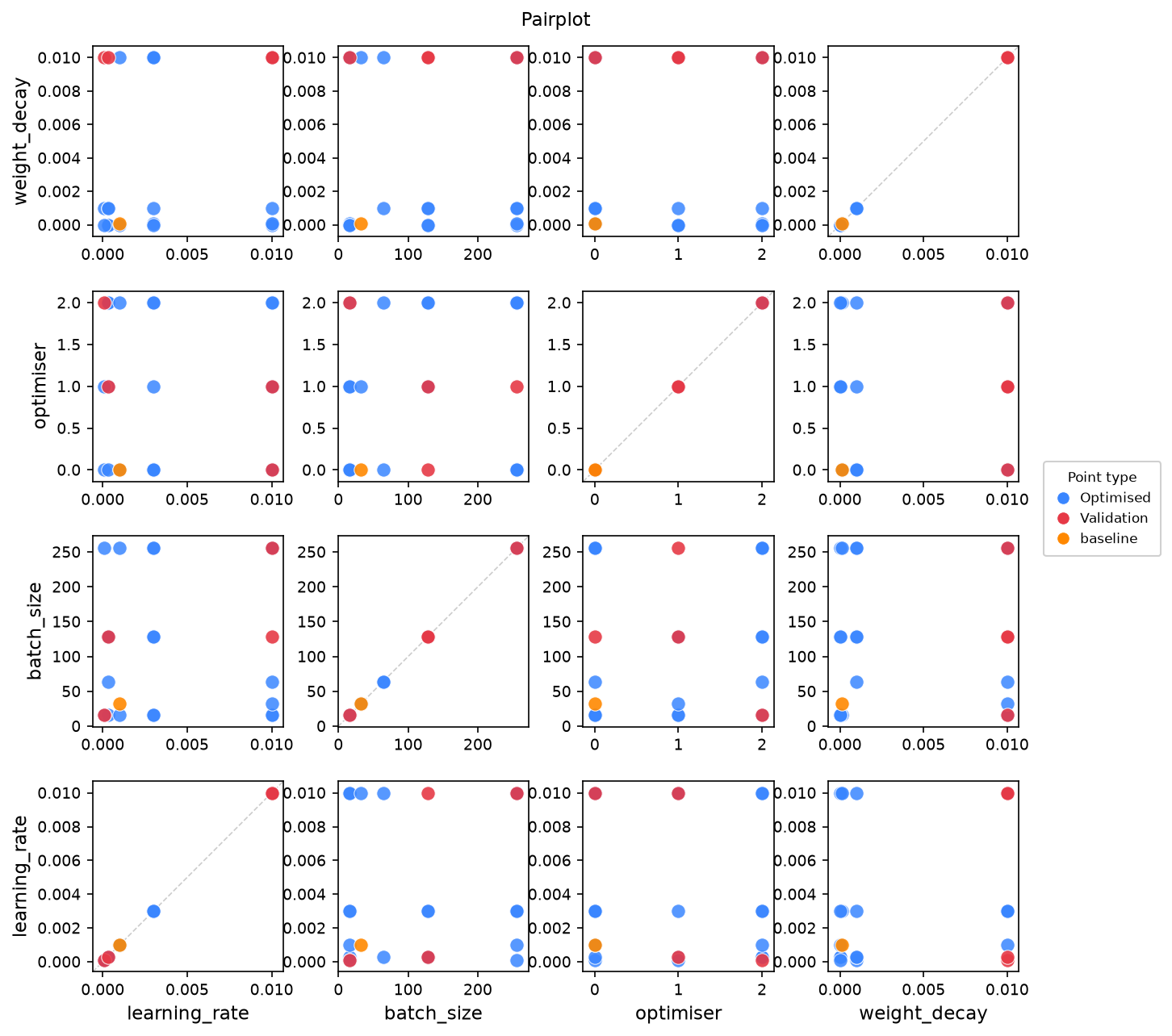
A hyperparameter design is built for training a model over four knobs: learning rate, batch size, optimiser, and weight decay. Instead of a full grid (which explodes combinatorially) or random search (which clusters and leaves gaps), a space-filling design covers the configuration space evenly with a modest number of runs. The optimiser is a nominal factor, so the design is scored with maxproqq. A fixed baseline configuration the team always wants to include is attached as its own set.
Parameters#
learning_rate (discrete decades: 1e-4, 3e-4, 1e-3, 3e-3, 1e-2): sampled on a log-like ladder rather than linearly, as is standard for learning rates.
batch_size (discrete powers of two: 16, 32, 64, 128, 256): the usual hardware-friendly choices.
optimiser (nominal: ‘adam’, ‘sgd’, ‘rmsprop’): unordered categorical.
weight_decay (discrete: 0.0, 1e-4, 1e-3, 1e-2): common regularisation strengths.
What to look at#
summary(): the space-filling configurations plus the always-included baseline set; note how few runs cover the space compared with a full grid (5 x 5 x 3 x 4 = 300 combinations).The saved pairplot: even coverage across the numeric knobs, with all three optimisers visited; the baseline configuration appears in its own colour.
configs.json: the design as JSON, the natural format when each row is a configuration consumed directly by a training script.
Mergen features used#
Log-like discrete numeric factors alongside a nominal factor.
criteria='maxproqq'as the correct choice for the nominal optimiser.Sampler.add_set(): pin a fixed baseline configuration that must always be part of the design.to_json export for configurations consumed by code.
Estimated runtime: a few seconds to a minute.
from mergen import ParameterSpace, Sampler

# 1. Define the hyperparameter space.
space = ParameterSpace({
    'learning_rate': [1e-4, 3e-4, 1e-3, 3e-3, 1e-2],
    'batch_size':    [16, 32, 64, 128, 256],
    'optimiser':     ('nominal', ['adam', 'sgd', 'rmsprop']),
    'weight_decay':  [0.0, 1e-4, 1e-3, 1e-2],
})

# 2. Always include a known-good baseline configuration.
sampler = Sampler(space)
sampler.add_set('baseline',
                [[1e-3, 32, 'adam', 1e-4]],
                color='#ff8800')

# 3. Build the space-filling design with maxproqq (nominal optimiser).
sampler.set_design(n_samples=20, n_validation=4)
result = sampler.run(criteria='maxproqq')

# 4. Inspect and export the configurations for the training script.
result.summary()
result.plot('pairplot', save=True)
result.to_json('configs.json')
  [WARNING]  n_samples (20) < recommended 10*n_parameters (40, Loeppky et al. 2009). Design quality may be reduced.

════════════════════════════════════════════════════════════
  MERGEN — Space-filling Design
════════════════════════════════════════════════════════════
  Parameters      : 4
  Candidates      : 300
  n_samples       : 20  (prescribed_in=0, focus_in=0, optimised_slots=20)
  Total design    : 20
  Validation      : 4
  Criterion       : maxproqq
  Algorithm(s)    : sa
────────────────────────────────────────────────────────────
  [MERGEN]   Optimising (criterion=maxproqq, algorithm=sa)...
  [SA]       Restart 1/5
  [SA]       Tuning temperature...
  [SA]       Start  log(score)=12.725  T=1.7640e+05  iters=2000  swappable=20  hybrid=0.50
    iter  500/2000  T=1.764e+04  best log(score)=12.075
    iter 1000/2000  T=1.764e+03  best log(score)=12.075
    iter 1500/2000  T=1.764e+02  best log(score)=12.024
    iter 2000/2000  T=1.764e+01  best log(score)=12.024
  [SA]       Done   log(score)=12.024  (accepted=1678/2000, rate=83.9%)
  [SA]       Restart 1: new best  log(score)=12.024
  [SA]       Restart 2/5
  [SA]       Tuning temperature...
  [SA]       Start  log(score)=12.385  T=1.6610e+05  iters=2000  swappable=20  hybrid=0.50
    iter  500/2000  T=1.661e+04  best log(score)=11.856
    iter 1000/2000  T=1.661e+03  best log(score)=11.856
    iter 1500/2000  T=1.661e+02  best log(score)=11.856
    iter 2000/2000  T=1.661e+01  best log(score)=11.856
  [SA]       Done   log(score)=11.856  (accepted=1639/2000, rate=82.0%)
  [SA]       Restart 2: new best  log(score)=11.856
  [SA]       Restart 3/5
  [SA]       Tuning temperature...
  [SA]       Start  log(score)=12.355  T=1.9463e+05  iters=2000  swappable=20  hybrid=0.50
    iter  500/2000  T=1.946e+04  best log(score)=11.881
    iter 1000/2000  T=1.946e+03  best log(score)=11.881
    iter 1500/2000  T=1.946e+02  best log(score)=11.861
    iter 2000/2000  T=1.946e+01  best log(score)=11.861
  [SA]       Done   log(score)=11.861  (accepted=1665/2000, rate=83.2%)
  [SA]       Restart 4/5
  [SA]       Tuning temperature...
  [SA]       Start  log(score)=12.191  T=1.4104e+05  iters=2000  swappable=20  hybrid=0.50
    iter  500/2000  T=1.410e+04  best log(score)=11.884
    iter 1000/2000  T=1.410e+03  best log(score)=11.884
    iter 1500/2000  T=1.410e+02  best log(score)=11.884
    iter 2000/2000  T=1.410e+01  best log(score)=11.884
  [SA]       Done   log(score)=11.884  (accepted=1641/2000, rate=82.0%)
  [SA]       Restart 5/5
  [SA]       Tuning temperature...
  [SA]       Start  log(score)=12.911  T=1.4254e+05  iters=2000  swappable=20  hybrid=0.50
    iter  500/2000  T=1.425e+04  best log(score)=11.928
    iter 1000/2000  T=1.425e+03  best log(score)=11.896
    iter 1500/2000  T=1.425e+02  best log(score)=11.896
    iter 2000/2000  T=1.425e+01  best log(score)=11.784
  [SA]       Done   log(score)=11.784  (accepted=1624/2000, rate=81.2%)
  [SA]       Restart 5: new best  log(score)=11.784
  [MERGEN]   sa     done -- score=1.311e+05  (elapsed 7.9s)

────────────────────────────────────────────────────────────
  MERGEN — Final Design
────────────────────────────────────────────────────────────
  Prescribed (in)  : 0
  Prescribed (out) : 0
  Focus (in)       : 0
  Focus (out)      : 0
  Optimised        : 20
  Total design     : 20
  Validation       : 4
  baseline          : 1
════════════════════════════════════════════════════════════

────────────────────────────────────────────────────
  MERGEN Design Summary
────────────────────────────────────────────────────
  Optimised       : 20
  Total design    : 20
  Validation      : 4
  baseline        : 1
────────────────────────────────────────────────────
  Parameters      : 4
  Candidates      : 300
  Criterion       : maxproqq
  Seed            : 44
  Algorithm       : sa
────────────────────────────────────────────────────

  Saved: outputs/pairplot_15.png
  Saved: outputs/configs.json  (25 rows)
Total running time of the script: (0 minutes 8.662 seconds)